The backdoor lives in the compiler, not the source
A Thompson-style compiler backdoor passes source audits, signatures, and reproducible builds because the validators are built by the same toolchain.
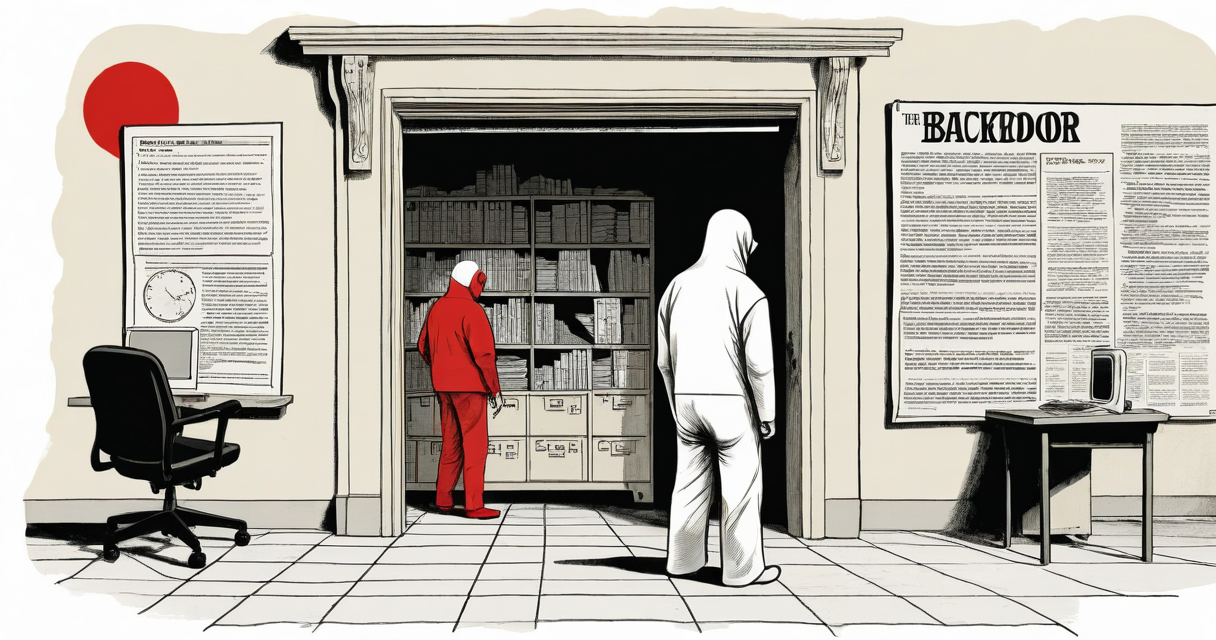
In 1984, Ken Thompson used his Turing Award lecture, ‘Reflections on Trusting Trust,’ to describe a backdoor that no source code review can find. The malicious logic did not live in any file a reviewer could open. It lived in the compiler binary. Applied to a full Linux distribution, the same technique compromises the one component every other control depends on: the toolchain that builds the software. Package signatures validate the output of a build. Checksum manifests validate the output of a build. The public availability of source validates what a human can read. None of these validate the tool that produced the running binary.
The standard model treats the compiler as a neutral instrument. It is not neutral. It is a program with execution authority over every binary in the archive, from the kernel to glibc to dpkg to sshd. If the compiler binary is compromised, the source can be clean, the maintainer signatures can be valid, and the builds can be bit-for-bit reproducible, and the shipped system is still backdoored. This is not an edge case bolted onto the model. It is the direct result of where trust is placed. Trust is placed at the source and at the signature. The compilation step sits between them, and nothing in the default model inspects it.
State the boundary plainly. The trust root of a Linux distribution is the build toolchain, not the source tree and not the signing key. The source tree describes intent. The signing key attests that a specific artifact came from a specific builder. The toolchain is what turns one into the other, and it is the only component that can silently disagree with both. In the default distribution model there is no enforced control at that boundary. The toolchain is trusted by assumption, and an assumption that is not validated is not a control.
The operating assumption behind open-source security is a chain: source is public, therefore source is auditable, therefore audited source produces trustworthy software. Package signing extends the chain by binding a built artifact to a maintainer identity, so a user can confirm the binary they downloaded is the binary that maintainer produced. Reproducible builds extend it further by proving that the same source, built again, yields the identical bytes, which removes the builder as a single point of trust. Runtime controls like SELinux and AppArmor sit on top, constraining what the resulting binary is permitted to do once it executes.
Each of these validates something real, and each validates only its own link. Source review confirms what the source says. Signature verification confirms who signed the artifact and that it was not altered in transit. Reproducible builds confirm that the transformation from source to binary is deterministic and independent of one machine. What none of them confirm is that the transformation itself is honest. There is a step in the middle of the chain that every other link assumes and none of them measures: the act of compilation, performed by a binary that was itself compiled by an earlier binary, back through a bootstrap history no signature covers.
That gap is the whole exposure. The model closes the loop from human-readable code to a signed, reproducible artifact, and it treats that loop as equivalent to a loop from code to trustworthy behavior. Those are not the same loop. A deterministic build is a build that reliably produces the same output. It says nothing about whether that output faithfully represents the source. Determinism and honesty are independent properties. The default model measures the first and infers the second, and the inference does not hold.
The compiler is a program that compiles programs, including its own source. That single property is what breaks the model. A compromised compiler binary can be written to recognize two specific inputs. When it detects that it is compiling a sensitive target, for example an authentication path such as login or sshd, it emits the correct object code plus an injected backdoor. When it detects that it is compiling its own source, it emits a correct compiler plus a copy of both behaviors, the target injection and the self-recognition. After the poisoned binary exists, the malicious source is deleted. From that point the compiler source audits completely clean, and building it with the poisoned binary reproduces a poisoned binary. The attack has moved out of source entirely and into the bootstrap lineage.
Scale this to a distribution and the observable behavior is precise. Clean source produces a poisoned binary. Thousands of packages built by that toolchain inherit whatever the toolchain chooses to inject, and every one of them audits clean at the source level because the injection is not in their source. Maintainer signatures sign the poisoned outputs, because the maintainers built exactly what they were supposed to build with the tool they were supposed to use. Reproducible-build verification passes, because two independent machines running the same poisoned toolchain against the same clean source reproduce the identical poisoned bytes. Every control in the default model reports green. Each one is doing its job correctly. The job simply never included the toolchain.
What failed is not a specific package, a specific key, or a specific build farm. What failed is the location of the trust boundary. The boundary was drawn around source and signature, and the execution context that actually determines binary behavior, the compiler and the chain that produced it, was left outside the boundary and validated by nothing. Identity is the boundary, and here the identity that mattered was the integrity of the toolchain. That identity was assumed, never continuously verified, and a boundary that is assumed rather than enforced is the boundary an attacker builds on. If a system allows an unverified tool to define the behavior of everything it produces, that outcome will occur wherever the tool is compromised.
The mechanism that defeats validation is not the injection. It is the position of the observer. Every tool that reports on the integrity of a Linux system was itself produced by the toolchain under examination. The checksum utility, the signature verifier, the diff tool used to compare reproducible builds, the shell that runs them, and the kernel that schedules them are all binaries the compiler emitted. When the instrument that measures integrity was produced by the component being measured, its report is only as trustworthy as that component. A poisoned toolchain that can recognize its own source can recognize the tools that would expose it. Nothing in the default model prevents that recognition, and nothing in the default model requires it to be ruled out.
The bootstrap lineage is where this becomes structural. Every compiler binary was produced by an earlier compiler binary. Trace that chain backward and it does not terminate in source. It terminates in a prior binary, and before that another, back to a seed whose provenance no current signature covers. The signing keys in use bind an artifact to a builder. They do not attest the lineage that produced the builder’s tools. So the question of whether the compiler is honest cannot be answered by any artifact the compiler produced, and that includes the compiler’s own recompilation, because the recompilation is performed by the suspect. The validation loop is closed inside the suspect. A component cannot be its own witness.
The observable behavior of this failure is uniform. Reproducible-build verification compares two outputs and declares a match, but both outputs descend from the same toolchain lineage, so the match confirms determinism and states nothing about honesty. Source audit reads files that the injection is not in. Signature verification confirms a build that faithfully executed whatever the toolchain instructed. Each control returns a true statement about a narrow property, and each stays inside the toolchain because the step outside requires a tool, and the only tools available were built by the thing that would need to be checked. The boundary that required independent validation is the same boundary that supplies every validator. That is the mechanism. It is not a defect in any one control. It is the geometry of where the controls come from.
This is not specific to compilers. Strip out the compiler detail and the shape is general: any tool that both transforms artifacts and produces its own successor can carry behavior that no source review of its inputs or its outputs will reveal. The enabling property is transformation authority combined with self-reproduction. The malicious logic does not need to live in source that anyone reads. It lives in the lineage, and the lineage regenerates it every time the tool rebuilds the tool. A base container image used to build the next version of that same base image has this property. Firmware that writes firmware has it. A package build system that is itself packaged by the toolchain it manages has it. In each case the artifact under review is produced by a predecessor of the same kind, and no source in front of the reviewer describes the inheritance.
The defense that works for ordinary code assumes the transformation is independent of the transformer’s history. Read the source, sign the output, rebuild deterministically, and for a normal program that is sufficient because the program does not manufacture its own compiler. Where the tool produces its own successor, that independence assumption is false, and every control built on it inherits the falsehood. The pattern is not supply chain risk in general. It is narrower and sharper: trust delegated to a self-reproducing tool compounds silently, because every generation inherits the last and no generation carries evidence of what it inherited. Auditing the output is exactly the wrong place to look, because clean output is the specific thing the mechanism is engineered to preserve.
What the pattern exposes is a fixed rule about trust placement. Auditing an artifact validates the artifact. It never validates the process that holds authority over the artifact, unless that process is brought under audit by an instrument the process did not create. Delegate trust to a tool that builds its own replacement and you have delegated trust to a chain that reports health at every checkpoint, because every checkpoint measures output. The health report is accurate and irrelevant. If the observer is built by the observed, the observer certifies nothing, no matter how many checks it passes. Green is a property of the output. The compromise is a property of the process.
The toolchain is inside the trust boundary. Draw it there or the boundary is fiction. The single control the mechanism does not already own is validation by an instrument the suspect did not produce, and that defines the only class of check worth running. Compile the toolchain’s source with a second compiler of independent origin. Use each result to build that source again. Compare the final binaries. A poisoned lineage present in one does not exist in the independently originated compiler, which does not share its self-recognition, so the outputs diverge and the divergence is the signal. The check works for one reason only. It introduces a validator the suspect did not build. Every validation that stays inside the lineage fails by construction. This one leaves it, which is why it is the only one that answers the actual question.
The operator conditions follow directly and none of them are optional. Provenance of the bootstrap seed is either established by an independent lineage or it is not confirmed, and not confirmed is a state to record, not a gap to fill with assumption. A signing key attests a builder and says nothing about the compiler that builder ran, so a valid signature must never be read as a statement about the toolchain. A reproducible build proves determinism and says nothing about faithfulness to source, so a reproducible build must never be read as a statement about honesty. And any control produced by the component it is meant to check is not a control. It is a reflection of the component, and it will report whatever the component was built to make it report.
The default Linux model places trust at the source and at the signature and leaves the transformation between them unverified. That is not a gap in the model. It is the model. Until the toolchain is validated by something outside its own lineage, every passing check in the pipeline is a statement about output, and output is the one surface a Thompson-style compromise is designed to keep clean. If a system allows an unverified tool to define the behavior of everything it produces, then the behavior of everything it produces is unverified, regardless of how many signatures cover it. Validate the toolchain against an independent origin, or state plainly that the trust root of the distribution is not confirmed. There is no third position.
Keep Reading
 sandbox escape
qBittorrent escaped its sandbox and owned the host
A sandbox controls what code can do, not what code is. When qBittorrent escaped confinement, provenance was the control that was never applied.
 supply chain security
Open source is not decentralized
Damn Interesting going paid is an indicator, not a failure: deep technical analysis concentrates value, and concentrated value gets targeted.
 systems failure analysis
The rubric graded an empty chair
Brown's AI cheating scandal is not a student failure. It is an assessment system that resolves trust by reference and never revalidates the reality behind it.
Stay in the loop
New writing delivered when it's ready. No schedule, no spam.