They knocked on his door, not his firewall
Danish police raided privacy activist Lars Andersen with no technical breach. The boundary moved to physical custody, where remote controls were never positioned.
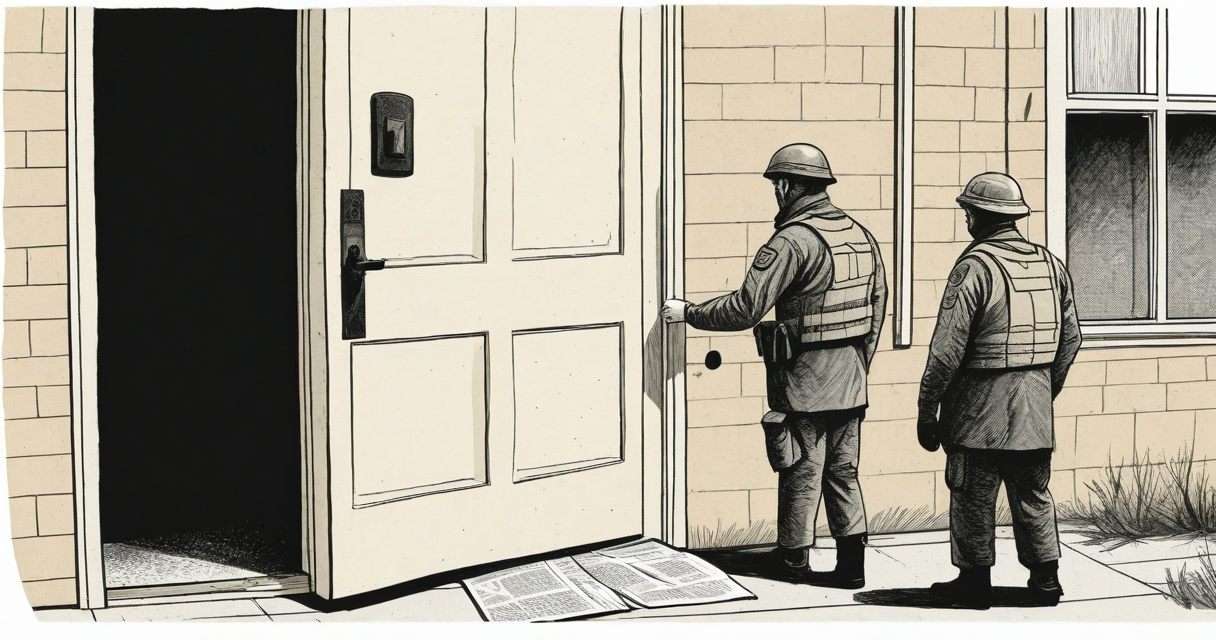
Danish police executed a raid against Lars Andersen, a privacy activist. That is the confirmed event. The target was the person. Not an exposed service, not an unpatched host, not a leaked credential. The action was directed at an individual and the physical space he occupied.
The detail that defines this case: there was no technical breach. The access did not route through a vulnerability in his systems. It routed through him. When the access path is the operator and the legal authority to reach the operator, encryption strength is not the control under test. Physical custody of the hardware is. A raid does not defeat a control. It relocates the contest to a layer where the control was never positioned.
State the position directly. Digital controls protect data against remote adversaries. They do not protect against an adversary holding legal authority and physical access to the operator and the operator’s devices. Those are two distinct threat models. A raid collapses the distance every remote control depends on. Once the boundary is the room the operator stands in, the assumptions behind the control set no longer hold. Whether any detention occurred is not confirmed. The raid is confirmed. The shift in boundary is what matters.
The operating assumption behind privacy activism is that disciplined digital hygiene reduces exposure to an acceptable level. Strong encryption, compartmentalized identities, minimized metadata. The model treats the adversary as remote and the defense as technical. Under that model, the boundary is the device and the network, and the operator sets the terms of access.
Andersen’s specific tooling is not confirmed. What encryption he ran, how he compartmentalized identities, whether devices were powered off or held in an unlocked state. None of that is stated. Treat it as unknown. The argument does not depend on it. The assumption under test here is structural, not specific to one stack. Reading his defenses as strong or weak would be inference, and inference is not confirmation.
The structural assumption is that the operator retains control of the conditions under which data is accessed. Remote-adversary models assume the operator chooses when a device is on, when a key is loaded into memory, when a session is authenticated. Every one of those assumptions requires continued physical control of the endpoint. The privacy posture is built on uninterrupted custody of the hardware and the operator’s own freedom of action. That is the load-bearing assumption, and it is rarely stated as one. A control that is never stated is never tested.
The raid removed the custody assumption. Police action placed the adversary in physical proximity to the operator and the space he occupied. What was seized is not confirmed. Whether any device was accessed, imaged, or decrypted is not confirmed. The confirmed change is the position of the boundary. It moved from the network to the physical environment the operator was in. That single change invalidates the conditions a remote-adversary control set assumes.
This is a change in adversary class, not adversary skill. A remote attacker must defeat the control to reach the data. A raiding authority does not defeat the control. It removes the operator’s ability to enforce it. There is no exploit in this path. There is legal authority and physical access. The topic frames Andersen as operating outside established legal frameworks. If that condition holds, it is the access path: legal exposure is what authorized the physical action. State that as the provided framing, not as confirmed detail. Specific charges are not confirmed.
What changed for the threat model is the enforcement point. Controls that depend on the operator being present to deny access, or absent to keep keys unloaded, do not survive the operator and the hardware sharing a room with the adversary. The defense set effective against remote intrusion did not fail technically. It was bypassed at a layer it never covered. Nothing in a remote-adversary control set addresses a lawful physical seizure of the person and the device. That distinction is the entire briefing. The boundary was always the operator. The raid only made it visible.
The mechanism here is not a defeated control. It is a relocated enforcement point. The externally observable behavior is limited and specific: police executed a raid at the operator’s physical location. What that produced was proximity. The control set Andersen’s posture is assumed to rely on was positioned at the network and the device, against a remote adversary. A raid places the adversary inside that perimeter. No control was broken at its own layer. The layer that mattered was never the one the controls occupied.
Remote-adversary controls hold only while the operator retains custody of the endpoint. That custody is what keeps three conditions under the operator’s control: whether the device is powered, whether key material is resident in memory, whether a session is authenticated. The device power state at seizure is not confirmed. Key residency is not confirmed. Lock state is not confirmed. The mechanism does not require any of those values. The mechanism is that all three conditions stopped being enforceable the moment the hardware left the operator’s hands. Enforcement did not fail. It transferred to the party now holding the hardware.
The drift is the distance between the threat model that was designed for and the threat model that arrived. A privacy posture is built and tested against remote intrusion. Physical seizure under legal authority is a separate adversary class. A control that is never tested against an adversary class does not hold against it by accident. State it without softening: the control set did not fail technically. It was applied outside the coverage it was designed for. Whether Andersen held any control positioned against physical custody is not confirmed. Absence of such a control is not a flaw to assume. It is a condition. Treat it as one.
The mechanism generalizes wherever the enforcement point is the operator’s continued physical control of the endpoint. Full-disk encryption enforces at one specific state: a device that is powered off and locked. That is the only state in which the cipher is the boundary. In any other state, the boundary is custody of the hardware. Once the device is held by another party in a powered or unlocked state, the holder sets the terms of access and the operator does not. This is the same mechanism, not a comparable one: the enforcement point moved off the operator, and the control that assumed otherwise no longer governs.
The same pattern applies to compartmentalized identities, ephemeral keys, and forward secrecy. Each of these depends on the operator controlling when material exists and when it is reachable. That control is exercised through the endpoint. Physical custody of an unlocked endpoint exposes whatever is resident and reachable at the instant custody is lost. Whether any such material was resident on Andersen’s devices is not confirmed. The pattern does not rest on that. The pattern is that every one of these controls assumes an adversary that never reaches the device in an accessible state. A physical-legal seizure is precisely the adversary that does. The control and the seizure operate at different layers, and the seizure sits below all of them.
There is a governing variable in this pattern, and it is not cipher strength. Where legal authority can compel physical access, the strength of the remote control is irrelevant to that path. The variable that decides whether the path is available is the operator’s legal exposure. The topic frames Andersen as operating outside established legal frameworks. As provided framing, that exposure is the access path: it is what authorized the physical action. State it as framing, not as confirmed detail, and the pattern still holds. Legal exposure determines whether the physical-access path is open to the adversary. No amount of encryption changes that variable, because encryption was never positioned against it.
The operator was always the boundary. The raid did not create that condition. It made it observable. Any privacy model that treats remote intrusion as the only adversary class is incomplete by design, and the gap is not in the cryptography. The gap is in the assumption that the operator retains custody of the conditions a control depends on. That assumption is load-bearing and it is rarely written down. A control that depends on an unstated assumption is conditional, not absolute.
Controls that are not enforced are not controls. A control whose enforcement requires conditions the operator cannot guarantee under seizure does not stop the behavior at that layer. It was never positioned there. The honest model separates two adversary classes and refuses to let strength against the remote one imply strength against the physical one. For an operator under the framing provided here, operating outside established legal frameworks, the dominant variable is legal exposure, not the choice of cipher. State that plainly. The two are not substitutes.
Encryption strength was not the control under test in this event. Physical custody was. What this raid defines is narrow and it is final: when the adversary holds legal authority and physical access to the operator and the hardware, the contest is decided at a layer no remote control occupies. Whether any device was seized, accessed, imaged, or decrypted is not confirmed. The boundary shift is confirmed, and it is the entire briefing. The control that matters at this boundary is the one positioned against custody loss. If that control was never placed, it was never a control. It was an assumption.
Keep Reading
 OSINT security
Your subject can end your investigation
A US ambassador used Belgian police to halt reporting. The failure is an unscoped trust channel from subject to enforcement, not a press dispute.
 reverse engineering
I reverse-engineered a 2002 GameCube before doing it legally
Decomp Academy turns matching decompilation into a teachable, verifiable skill, which exposes why compiled opacity was never a real security control.
 platform surveillance
The surveillance doesn't have to be real
An author alleges Meta surveilled her for 12 months. The act is unconfirmed; the capability is structural and built into centralized identity.
Stay in the loop
New writing delivered when it's ready. No schedule, no spam.