The smooth line hiding a noisy benchmark
The METR AI time horizons graph contains structural errors that mislead teams building agents, automation, and AI workflows. Here is what it actually shows.
1. Straight Answer
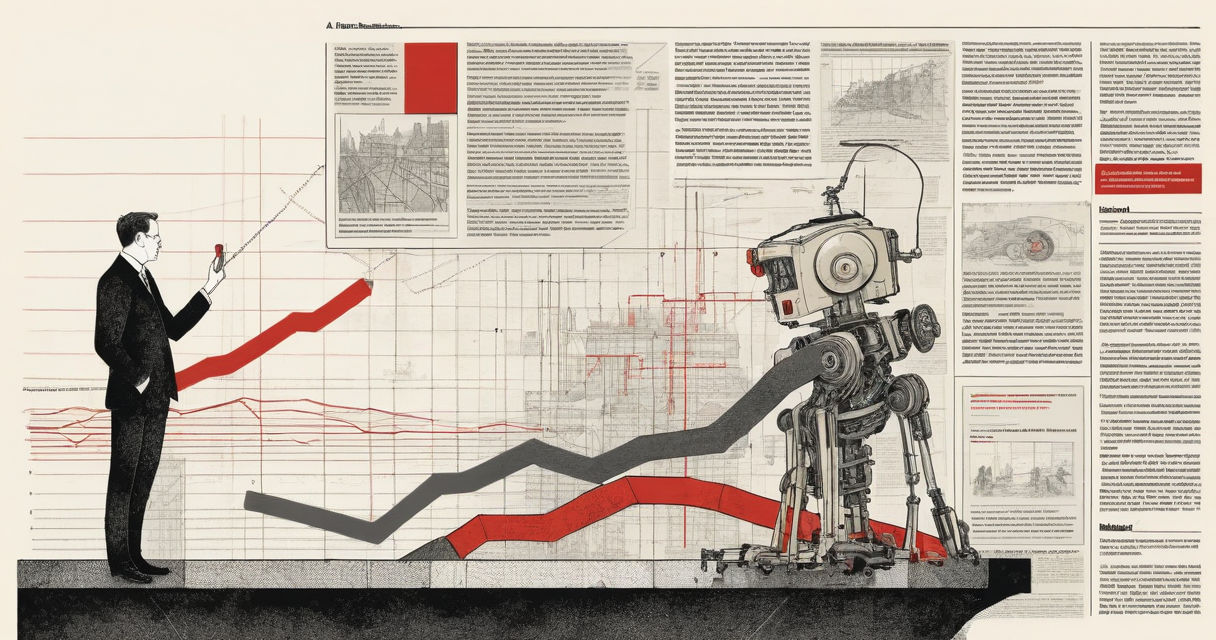
The METR time horizons graph is treated as if it shows a clean exponential curve of AI capability doubling every few months. It does not. The chart compresses a noisy, narrow, task-specific benchmark into a smooth trend line and then invites readers to extrapolate that line into claims about general AI competence. The errors are not cosmetic. They are structural, and they shape how teams are now planning hiring, automation, and product roadmaps.
The core problems break down into three categories. First, the underlying task set is narrow and biased toward software-engineering style problems with clear pass/fail criteria, which is the easiest possible terrain for current models. Second, the y-axis quantity, the so-called human time horizon a model can match, is derived from human completion-time estimates that vary by an order of magnitude depending on who you ask. Third, the trend line is fit across a small number of models with selection effects baked in, then projected forward as if it were a physical law. Each error is defensible in isolation. Stacked together they produce a chart that looks rigorous and behaves like marketing.
This matters because the graph is being cited in boardrooms, policy briefings, and engineering planning docs as evidence that autonomous agents capable of multi-hour or multi-day work are arriving on a fixed schedule. That conclusion is not supported by the data. Teams building real systems on that assumption are about to discover a gap between the curve and the workflow, and the gap is where their budgets will disappear.
2. What’s Actually Going On
METR’s methodology measures how long a competent human takes to complete a task, then checks whether a model can complete the same task with some success rate, typically fifty percent. The horizon plotted for each model is the human-time length at which the model crosses that threshold. The headline finding is that this horizon has been doubling roughly every seven months. The visual is striking, the math is clean, and the framing is intuitive. It is also doing a lot of work that the underlying measurement cannot support.
The task suite leans heavily on closed-world problems: code that either runs or doesn’t, math that either checks out or doesn’t, research questions with verifiable answers. These are domains where verification is cheap and the search space is bounded. Real work is the opposite. A senior engineer’s four-hour task usually involves ambiguous requirements, stakeholder negotiation, partial information, legacy constraints, and a definition of done that emerges during the work itself. None of that is in the benchmark. So the horizon is not measuring how long a model can do useful work. It is measuring how long a model can do a particular kind of structured, gradable work that resembles a take-home interview.
The human baseline is even shakier. To say a model has a four-hour horizon, you need to know how long a human takes on the same task. METR’s human times come from small samples, often a single contractor, sometimes with wide confidence intervals that are smoothed away in the plot. A task labelled as four hours might take one engineer ninety minutes and another a full day. When the y-axis is built on estimates that wobble by 5x, plotting a doubling trend with neat error bars overstates the precision of the entire exercise. The exponential fit is then drawn through a dozen or so model points, with the earliest models defining the slope and the latest models defining the ceiling. Change the task mix, change the human raters, or include a few additional models, and the doubling time shifts noticeably. That is not a stable empirical law. It is a regression artifact dressed up as a forecast.
3. Where People Get It Wrong
The most common mistake is treating the horizon as a measure of autonomy. It is not. A model that succeeds on a four-hour benchmark task with fifty percent reliability is not an agent that can be left alone for four hours. Fifty percent is a coin flip. In production, that means every long-running task needs supervision, checkpointing, and rollback, which collapses the supposed time savings. Teams who read the graph as a promise of autonomous multi-hour agents are building orchestration layers around a capability that does not exist yet, and the maintenance cost of those layers will dwarf the work the agent was supposed to replace.
The second mistake is extrapolation. Drawing a straight line on a log plot and projecting it two years forward assumes the same dynamics that produced past gains will continue to produce them. There is no mechanism in the graph that explains why doubling happens or what would cause it to stop. Scaling laws, training data availability, reasoning techniques, and tool use are all distinct contributors with their own ceilings. Bundling them into a single trend line hides the fact that recent gains have come disproportionately from inference-time compute and tool scaffolding, not raw model capability. Those levers have different cost curves and different limits. The line on the chart does not know that.
The third mistake is the one that hurts builders most directly. Reading the graph encourages a planning mode where you assume future models will handle longer and longer tasks end-to-end, so you defer investment in pipelines, validation layers, and structured workflows. You wait for the model to catch up to the problem. Meanwhile, the teams getting real results are doing the opposite. They are decomposing long tasks into short, verifiable steps, wrapping each step in deterministic control, and treating the model as a component with a known failure rate rather than an employee with a growing skill set. The horizon graph makes the wrong approach look like the patient one. In practice it is the one that ships nothing.
The drift starts the moment a benchmark designed for measurement gets used for forecasting. METR’s horizon number is a snapshot of model behaviour on a specific task distribution under specific scoring rules. Once that number is plotted against time and fitted with an exponential, it stops being a measurement and becomes a prediction. The prediction then gets imported into planning documents that have no relationship to the original task suite. A product lead reads four hours and thinks customer onboarding. An engineering director reads four hours and thinks incident response. Neither of those workflows is in the benchmark, and neither has the closed-world verification that makes the benchmark tractable. The number survives the translation. The conditions that made it meaningful do not.
The failure mode compounds because the graph rewards a particular kind of architectural laziness. If you believe horizons are doubling every seven months, the rational move is to wait. Why invest in decomposition, validation, retry logic, and human-in-the-loop checkpoints when the next model will handle the whole task in one shot? So teams build thin wrappers around frontier APIs, ship demos that work on cherry-picked inputs, and defer the engineering that would have made the system robust. Six months later the new model arrives, the demo still breaks on the same edge cases, and the team has nothing to show except a higher API bill. The graph did not cause this pattern, but it gives it permission. It tells leadership that patience is a strategy.
The deeper structural problem is that the horizon metric collapses two distinct quantities into one. There is task length, which is a property of the work, and there is task complexity, which is a property of the decision tree the worker has to navigate. A four-hour task with linear structure and clear feedback is fundamentally different from a four-hour task with branching dependencies and ambiguous criteria. Current models handle the first reasonably well and the second poorly, but the graph plots them on the same axis. So a model that improves on linear tasks looks like it is moving up the curve toward general competence, when what it is actually doing is getting better at a narrow slice and leaving the rest untouched. By the time a team notices the gap, they have already staffed and scoped the project around the wrong assumption.
This is not the first time a benchmark curve has been mistaken for a roadmap. ImageNet accuracy followed a similar arc in the early deep learning years. Top-five error rates dropped year over year, the chart looked exponential, and a generation of startups built business plans around the assumption that computer vision was solved. What actually happened was that ImageNet performance saturated, real-world deployment ran into distribution shift, lighting conditions, adversarial inputs, and labelling ambiguity, and most of those startups quietly pivoted or shut down. The benchmark kept improving. The applications kept failing. The gap between the two was the part the chart could not show.
The same pattern shows up in self-driving. Disengagement rates per mile followed a tidy downward trend on the slides that every major player presented to investors between 2017 and 2020. Extrapolating those lines suggested full autonomy was eighteen to thirty-six months away on a rolling basis for almost a decade. The metric was real. The progress was real. But the long tail of edge cases, the regulatory environment, and the operational cost of remote supervision were not on the chart. The companies that survived stopped pitching the curve and started building narrower deployments with hard operational constraints: geofenced routes, fixed speeds, supervised corridors. The ones that kept pitching the curve burned through capital waiting for the line to deliver what it had implied.
The lesson generalises. Any time a single number is plotted against time and fitted with a smooth function, the chart is doing two jobs. It is summarising past measurements, which is legitimate, and it is encoding a theory of future behaviour, which is usually not. The METR graph is in the second category. Treat it the way you would treat a Moore’s law extrapolation in 2010, or an ImageNet curve in 2014, or a Waymo disengagement chart in 2018. Useful as a coarse indicator of direction. Dangerous as a basis for capital allocation, hiring decisions, or product timelines. The people who built durable businesses in each of those eras did so by ignoring the curve and engineering around the actual capability they had in hand.
The METR graph is not wrong because the researchers were careless. It is wrong because no single curve can carry the weight that the discourse is putting on it. A benchmark measures what it measures. The moment it is asked to predict autonomous agent capability, workforce displacement timelines, or AGI arrival windows, it is being used outside its design envelope. The chart’s authors have been reasonably careful in their own framing. The damage happens downstream, in the slide decks and the LinkedIn threads and the strategy memos, where the error bars get cropped and the caveats get dropped and the line becomes prophecy.
For anyone actually building, the practical implication is simple. Stop calibrating your roadmap to extrapolations of a benchmark you did not run on tasks you do not perform. Calibrate to the work in front of you. Measure your own systems against your own task distribution with your own scoring rules. If a model has a fifty percent success rate on your workflow, that is the number that matters, not the horizon plotted in a paper. Build decomposition, validation, and recovery around that real number. When the model improves, your pipeline improves with it. When it does not, you still have a working system.
The teams that will own the next two years are the ones who treat AI capability as a moving but bounded resource, not a rising tide that lifts every architecture. They will keep their pipelines short, their interfaces structured, their failure modes visible, and their humans in the loop where it counts. They will read graphs like METR’s for signal, not for strategy. The curve goes where it goes. The work is what you ship.
Keep Reading
 LLM engineering
Same task, different bets
Claude, Codex and Cursor pick different tools across 17k runs - here is how to measure that revealed policy and wrap it in controls before it hits production.
 Hy3 LLM
Hy3 is quietly winning production
Hy3 is topping OpenRouter rankings with no public lineage. NovaMind breaks down what its dominance means for pipelines, automation, and team design.
 Mistral AI
The bottleneck moved past the model
Notes from the Mistral AI Now summit on what the new enterprise stack means for automation pipelines and workforce transformation.
Latest on the Wire
Full wire →- AI Ends the Fixed-Function App — and the Author Is Building a Phone for ItHacker News
- Appeals Court Backs Pentagon's Blacklisting of Anthropic Over ClaudeHacker News
- Botched Samsung firmware update bricks smart fridges, spoils food before Korean holidayHacker News
- DHH's Rails World keynote pulls a flagship app off Rails and bets everything on LLMsHacker News
New signal daily · RSS
Stay in the loop
New writing delivered when it's ready. No schedule, no spam.