Flock's real attack surface was never the camera
Flock ALPR cameras are a national sensor grid - the security risk isn't recording, it's a queryable movement database reachable by thousands of weak accounts.
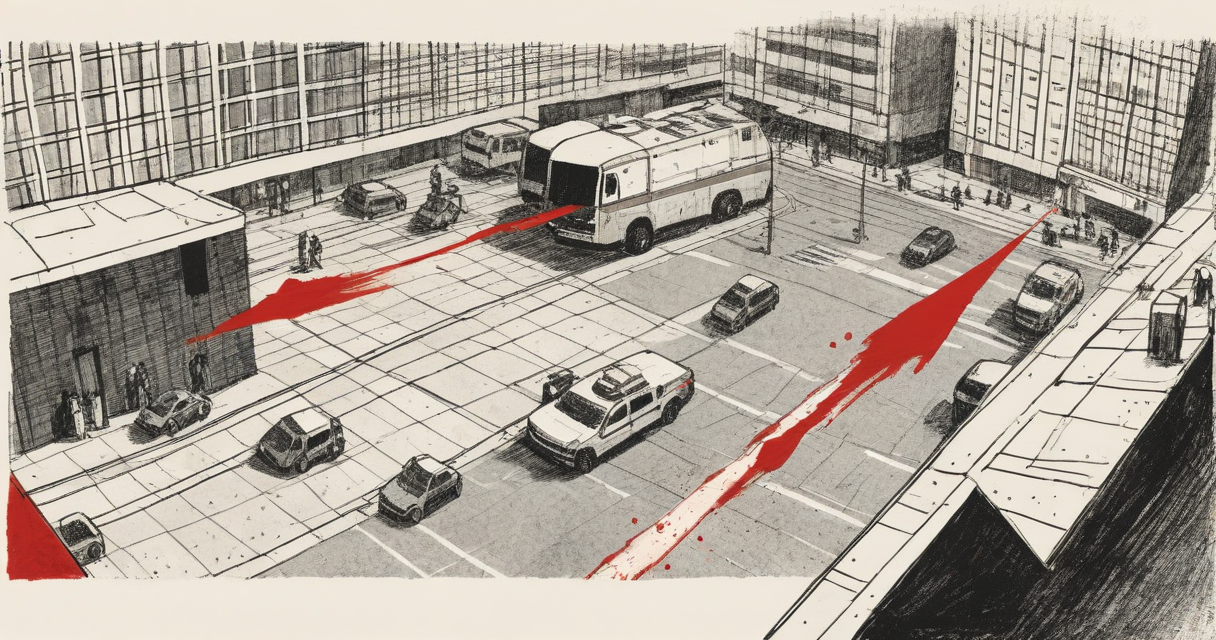
Flock Safety operates one of the largest privately held sensor networks in North America. Automated license plate readers, marketed as ALPR, deployed across more than 5,000 communities. Tens of thousands of camera units sit on public roads, residential entrances, and retail lots. Each unit is a solar-powered edge device: a camera, an onboard inference accelerator, a cellular modem, embedded Linux underneath. The devices do not only read plates. They generate a vehicle fingerprint - make, model, color, body style, roof rack, bumper stickers, dents, aftermarket decals. The plate is a single field. The record is the asset. And the record is queryable across a shared national lookup network.
The consumer privacy argument stops at who reads the data. The security argument starts one layer down. Who owns the sensors. Who owns the query interface. Who owns the aggregate. Those are three different targets with three different exploitation economics, and only one of them is about a camera.
No headline CVE anchors this analysis. That is the point. The exposure is architectural, not a single memory-corruption primitive waiting on a patch Tuesday. A distributed fleet of internet-reachable embedded devices, centrally orchestrated through a cloud console, feeding a persistent geolocation database that thousands of accounts can search. Each of those four layers - the edge device, the cellular backhaul, the FlockOS management plane, and the cross-agency trust relationships - is a distinct attack surface. Compromise value increases as the target moves up the stack. One camera yields one street. The console yields a nation of movement history.
Start at the edge. Public hardware teardowns of Flock units show what commodity surveillance hardware always shows: an ARM SoC, a stock embedded Linux build, an LTE modem, and firmware update paths that trust a remote endpoint. This is standard IoT construction. The relevant bug classes are not exotic. Exposed management interfaces reachable over the cellular link, weak or shared device credentials, unauthenticated local APIs, firmware served without signature verification, and web consoles that were never meant to face the public internet but end up there through misconfiguration. Security researchers and journalists documented exactly this pattern across ALPR deployments through 2025 - misconfigured units, publicly reachable footage, and audit trails that did not hold up to scrutiny. A management interface exposed to the internet with a default or reused credential is a CVSS 9.x condition on any scoring rubric, whether or not anyone assigns it a number. The device does not need a novel exploit. It needs to be found and logged into.
Finding them is trivial. T1595, active scanning. T1592, gathering victim host information. Cellular-connected devices with predictable service banners are enumerable through internet-wide scan data the same way any exposed camera fleet is. The DeFlock project already crowdsources physical camera locations at national scale. The digital equivalent - enumerating reachable management endpoints - is the same discovery problem run against a different index. Once a device is located and reachable, the intrusion is T1190, exploitation of a public-facing application, or T1078, valid accounts, if credential material has leaked or been reused. Neither requires nation-state tooling. Both are within reach of a competent criminal crew.
The edge device is not the objective. A single camera is a tactical asset - it watches one intersection. The persistent-intelligence prize is the aggregation layer. The FlockOS console and its search API expose the fused output of the entire fleet a given tenant can see, and the national lookup network extends that reach across jurisdictions through data-sharing agreements. Compromise a valid console account and the attacker inherits T1213, data from information repositories, at continental scale. Not one street. Every plate that passed any participating camera, with timestamps, coordinates, and vehicle fingerprints, retained by default long enough to reconstruct pattern-of-life on an arbitrary vehicle. T1119, automated collection, becomes a scripted query loop against an API that was built to answer exactly those questions for legitimate users.
That is the capability a nation-state buys with a single credential. Persistent geolocation intelligence on any target that drives. Counterintelligence value is immediate - track the movements of a specific plate tied to a person of interest, map the routes of a facility’s staff, identify surveillance-detection routes by watching who circles. This is passive collection against a database someone else built, powered, and maintained. The adversary supplies one compromised account and inherits a national movement graph. The intelligence tradecraft term for this is a gift.
Criminal use is lower and more direct. Locate a specific vehicle before a robbery or a hit. Confirm a target’s home-to-work pattern. Identify when a residence is empty by absence of the resident’s car. Insider misuse of ALPR systems by authorized personnel is already documented and recurring - officers running searches for personal reasons, unlogged or thinly logged. An external actor with a stolen credential does the same thing with none of the accountability, because the account belongs to someone who will get the blame. T1199, trusted relationship, is the cleanest path in. The weakest identity in the entire sharing network - one poorly secured municipal account, one reused password, one un-phishing-resistant MFA enrollment - becomes an entry point into the shared graph.
Now the telemetry reality, which is where defenders should be paying attention and mostly are not. A solar-powered ALPR camera on a residential pole is not an enterprise endpoint. It runs no Sysmon. It emits no Event ID 1 for process creation, no Event ID 10 for suspicious handle access, no Event ID 3 for outbound connections that any SOC will ever ingest. Windows Security event 4624 does not exist in this world. The device’s own compromise produces zero signal inside any SIEM a defender operates, because the defender operates none of the infrastructure. The cellular backhaul is the carrier’s. The management plane is the vendor’s. Network IOCs - beaconing, exfiltration, C2 - traverse links no victim can tap. The structural blind spot is total. A camera fleet can be surveilled, enumerated, and abused, and the only party positioned to see it is the vendor.
The management plane is the one place telemetry exists. FlockOS records searches, and audit logging on the query API is the single control that can catch account abuse after the fact. That control depends entirely on the vendor’s logging fidelity, retention, and willingness to surface anomalies to tenants - anomalous query volume, off-hours access, searches from new geographies, credential use inconsistent with an account’s normal pattern. Those are the correlation rules that matter here, and they live in a system practitioners do not administer. Detection engineering for this threat is not something a downstream SOC can build. It is something that either exists in the vendor’s console or does not. When it does not, credential-based abuse of a national surveillance database looks identical to legitimate use, because functionally it is legitimate use by the wrong hands.
What remains after every patch is applied. Assume the edge firmware is hardened, the exposed interfaces are pulled off the public internet, and every device credential is unique and rotated. The residual exposure is the aggregation itself. A persistent, queryable, national record of vehicle movement, reachable by thousands of federated accounts across jurisdictions with uneven identity controls, is a concentration of intelligence value that no device-level fix reduces. The database is the vulnerability. Its existence and its reach are the condition an adversary exploits, and neither is a bug. Both are the product working as designed.
This is critical-infrastructure-grade collection running on consumer-grade operational security. Under the Australian framing - the SOCI Act’s treatment of systems whose compromise carries national consequence, and the Privacy Act’s expectations on retention and access minimization - a sensor grid of this reach would sit squarely inside the regulated perimeter. It largely does not, on either continent, because it was sold as a policing tool rather than classified as the surveillance infrastructure it is. The gap between what the system holds and how it is governed is the exposure.
For anyone responsible for a jurisdiction that runs these devices, or a target whose movements this data would compromise, the finding does not belong in a blog comment. It belongs with the vendor’s security team, the operating agency, and the relevant national coordination body, through coordinated disclosure. The mechanism is understood well enough. Specific exploitation of live, deployed devices is not the contribution anyone needs. The threat model is.
The cameras are spreading because they are cheap, subsidized, and easy to deploy. Every unit added expands the graph, and the graph is the asset an adversary wants. The recording capability is not the threat. The network is.
Keep Reading
 grapheneos
Spanish police flagged GrapheneOS as suspicion
Authorities treating GrapheneOS as a targeting signal inverts threat intel logic and exposes the wrong population to scrutiny. The mechanism breakdown.
 vulnerability-research
XBOW topped HackerOne in 2025 and fixed nothing
Vulnerability research rewards finding, not fixing. Exploitation tracks disclosure, not the flaw. Why attackers react to reported CVEs, and where telemetry goes blind.
 vulnerability-management
The copy runs past the allocation, again
Recurring dystopian tech vulnerabilities persist because defenders patch the CVE instance and never hunt the underlying mechanism. The inaction is the vuln.
Stay in the loop
New writing delivered when it's ready. No schedule, no spam.