An hour-old account drops forty working exploits
A coordinated dump of forty anonymous 0-days breaks your triage queue, not your servers. Engineer response throughput and pre-authorized action before the burst.
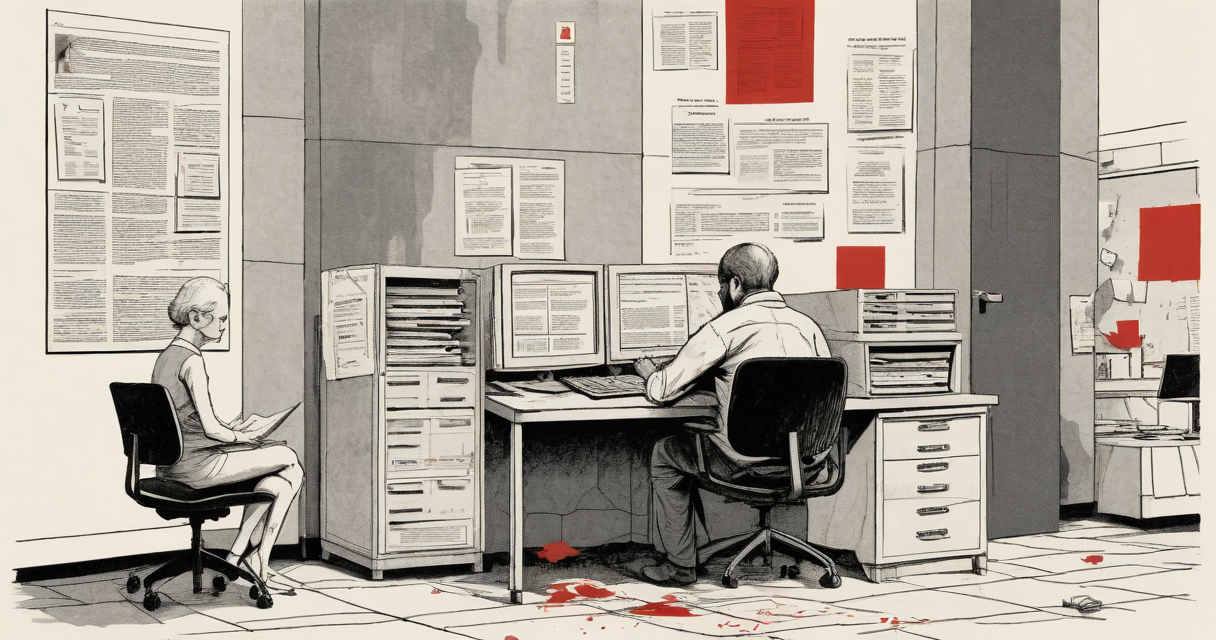
A GitHub account with no commit history, no linked identity, and a username generated an hour earlier publishes forty working exploits in a single afternoon. Each one targets a different widely-deployed library. None were reported to any vendor first. Within hours the same payloads are running inside commodity scanners, and the traffic hitting your edge is no longer a probe from a curious researcher - it is a coordinated sweep firing every one of those forty exploits against every asset it can reach. Nothing about this scenario is exotic. The tooling to do it has existed for years, and the marginal cost of dropping forty exploits instead of one is now close to zero.
The mistake almost every team makes in that moment is to look at the forty vulnerabilities. That is the wrong object. The vulnerabilities are not the failure. The failure is that your entire response system was built to handle one exploit at a time - traceable, scorable, prioritizable, patchable in sequence. Feed it forty simultaneous, anonymous, weaponized drops and the software you are trying to protect is not the first thing that breaks. Your triage queue is. Your on-call rotation is. Your change-approval process is. The attack does not overwhelm your servers; it overwhelms the human-and-ticket pipeline you use to decide what to do about your servers.
So the straight answer is this: stop measuring your exposure by the number or severity of individual CVEs, and start measuring the throughput of your response system under a burst. The number that matters is not “how fast can we patch one critical bug” but “how many independent, severe, unverified threats can we absorb, decide on, and act against per hour before the queue grows faster than we can drain it.” A mass drop is not a security event in the traditional sense. It is a capacity event. And capacity events are won or lost on architecture that was decided months before the flood arrived, not on heroics during it.
To see why this happens the same way every time, look at how vulnerability response is actually built inside most organizations. The pipeline assumes scarcity. A report comes in, someone assigns a severity, a ticket is created, an owner is found, the fix is scoped, tested, approved, and deployed. That flow is fundamentally serial and human-gated at its most important decision points. It works because, historically, severe exploits arrived slowly enough that the service rate of the pipeline comfortably exceeded the arrival rate of new threats. The whole design - CVSS scoring, per-vulnerability tickets, human sign-off before a production change - is an artifact of a world where the expensive, scarce resource was the exploit, not the response.
A mass drop inverts that economics. The attacker side is now fully automated end to end: discovery scanners, exploit weaponization, and increasingly model-assisted adaptation that reshapes a public proof-of-concept to fit your specific stack without a human ever reading it. The defender side still has people at the decision nodes. That asymmetry is the actual vulnerability, and it is a structural one. When forty severe threats land in the same window, every stage that quietly assumed serial processing becomes a bottleneck at once. Arrival rate exceeds service rate. The queue does not degrade gracefully - it grows without bound until something outside the system, usually exhaustion or an outage, forces it to stop. This is basic queueing behavior, and it is why the chaos is predictable. Given a burst that exceeds a pipeline’s drain rate, the collapse is not bad luck. It is the deterministic output of an under-provisioned system meeting a load it was never dimensioned for.
The anonymity is not decoration either; it removes a control the whole model leaned on. Traditional response assumes you can partly triage by attribution and intent - who is this, what do they want, is this targeted or opportunistic. That reasoning is how humans cut a large threat list down to a workable one. A faceless account dropping forty unrelated exploits gives you no attribution to reason about and no deterrence to fall back on. Every item has to be treated as live and hostile, because you cannot cheaply prove any of them is not. The step your analysts relied on to shrink the problem is gone, so the full, unfiltered load hits the part of the pipeline least able to scale: human judgment.
Where people get this wrong starts with the instinct to patch faster. Patch speed is not the binding constraint in a flood, and optimizing it harder does not help. The scarce resource is not the availability of fixes - it is decision throughput: the rate at which your organization can classify a threat, confirm whether it applies to you, decide on an action, and authorize that action in production. You can have every patch ready and still lose, because the queue jams at the decide-and-authorize stage long before it jams at deploy. Teams pour effort into shaving minutes off their patch cycle and are then genuinely surprised when a coordinated drop still buries them, because they optimized a stage that was never the bottleneck.
The second wrong turn is to answer a scaling problem by adding uncoordinated capacity - more analysts on the bridge, or, lately, a swarm of AI agents pointed at the alert queue. Adding workers to a saturated, tightly-coupled pipeline usually makes it slower, not faster, because coordination overhead grows faster than the work gets done. Naive agents make this worse in a specific way: each one produces output that a human then has to verify, so an unconstrained agent fleet does not drain the queue, it manufactures a second queue of things to check. Automation without hard constraints and validation does not match the attacker’s automation - it just amplifies whatever your decision process would have gotten wrong, at machine speed and across forty threats at once.
The deepest error is treating a mass drop as a bigger version of an isolated breach. It is a different category of event, and the metrics give it away. Organizations track mean-time-to-respond per incident and tune for average load, then get hit by a burst whose entire nature is that it violates the average. A system engineered for the mean will always fail at the tail, and a coordinated exploit dump is a tail event by construction. The reframe that actually changes outcomes is to stop asking “how do we respond to this exploit” and start asking “how does our operational architecture behave when severe, unverifiable threats arrive faster than any human can read them.” That question moves the work off the individual vulnerability and onto the shape of the system that has to survive many of them at once - which is exactly where the leverage has quietly moved.
The fix is to engineer the response pipeline the way you would engineer any system expected to survive a load spike: admission control, parallelizable stages, and pre-authorization. Start by splitting the two things a mass drop collapses into one - ‘does this threat apply to us’ and ‘what do we do about it.’ The first is a lookup, not a judgment. Most teams cannot answer ‘do we even run this library, at this version, on a reachable path’ in under an hour, because that inventory lives in people’s heads and in stale spreadsheets. Build a queryable asset-and-dependency inventory - an SBOM joined to a runtime exposure map - so that when forty exploits land, thirty of them are eliminated by a database query in seconds, not by an analyst reading advisories one at a time. That is not patch speed. That is cutting the arrival rate before load ever reaches human judgment, which is the only stage that cannot scale.
Then pre-authorize the actions. The change-approval gate exists because a production change is risky, but you can decide your risk tolerance in advance, per class of action, when no one is under pressure. Define standing playbooks tied to conditions, not to specific CVEs: if an affected path matches rule set X, apply a reversible edge mitigation automatically; if it matches Y, isolate the service; if Z, page a human. Reversible, low-blast-radius mitigations - rate limits, feature flags, WAF rules - convert the slowest human-gated stage into an automated one for the common cases, and reserve human judgment for the genuinely ambiguous minority. The point is not to remove people. It is to raise the service rate of the pipeline until it exceeds burst arrival rate, because that inequality is the entire game.
This is also the only place automation earns its seat. A model or agent is useful here not as an oracle that decides, but as a constrained classifier inside a validated pipeline. Given a public proof-of-concept and your inventory, have it extract the affected component, version range, and preconditions as structured JSON - then check that output against your inventory deterministically. The model does the messy natural-language reduction that humans cannot parallelize: reading forty advisories at once. The deterministic layer does the deciding and the verifying. Every model step has a schema behind it and a validation check after it. That is the difference between automation that drains the queue and automation that builds a second one - constraints, structured output, and a hard gate on everything the model emits. An agent that acts without that gate does not match the attacker’s automation. It just spreads your worst classification across forty threats at machine speed.
And you have to measure the thing you claim to be defending. Run the drill. Inject forty synthetic advisories on a normal Tuesday and time how long the pipeline takes to classify, decide, and act. That number is your drain rate, and it is the only honest input to how large a burst you can absorb. Most teams have never measured it and are guessing. If the drill buries you at forty, it will bury you in production at forty, and the fix is architectural - more elimination at the lookup stage, more pre-authorized actions - not a promise to try harder next time.
Consider a payments-adjacent SaaS company running roughly two hundred services, hit by an anonymous drop of forty working proof-of-concepts on a Friday afternoon. The typical version of this team turns each advisory into a ticket. Security engineers cross-reference by hand, argue severity, chase service owners who have gone home, and escalate to an on-call who is now reading exploit code at 9pm. By hour six they have triaged eleven of forty. The queue is growing faster than they are draining it, the change-approval process is jammed at the decide-and-authorize stage exactly as queueing behavior predicts, and the only thing that eventually stops the bleeding is exhaustion and a weekend.
The architected version of the same team receives the same forty. An ingestion job pulls the proof-of-concepts, a model extracts structured fields for each - component, version range, preconditions, network exposure - validated against a schema before anything downstream trusts it. A deterministic join against the SBOM and exposure map eliminates thirty-one in about ninety seconds: not deployed, or the running version is outside the affected range, or the service is not reachable from the network path the exploit needs. Nine remain. Six of those match a pre-authorized edge-mitigation rule and get virtual-patched automatically with a reversible WAF change, each one written to the audit ledger. Three are genuinely ambiguous - a novel precondition on a business-critical service - and those page two engineers, who now face three well-scoped decisions instead of forty unscoped ones.
Same flood, same forty vulnerabilities, same patches available at the same time. The entire difference sits in the response architecture, and it was decided months earlier. The architected team did not patch faster; it shrank the problem before it reached a human and pre-decided the routine actions. Residual human load went from forty to three. The trade-offs are real and worth stating plainly: this depends on an inventory that is accurate, which is the hard part and which rots the moment you stop automating it; it accepts that some auto-mitigations will occasionally block legitimate traffic, which is why every one of them must be reversible; and it lives or dies on validating the model’s extraction, because a missed precondition becomes a false ‘not affected’ and a silent gap. None of that is free. All of it is dimensionable in advance, which is the whole reason it works.
The mass drop is a preview, not an anomaly. The marginal cost of coordinated, automated, model-assisted attack is falling toward zero, and the adaptation curve - public exploits reshaped to fit your specific stack with no human in the loop - only bends one way. So the burst you plan for is not forty. It is whatever number makes your pipeline’s arrival rate exceed its drain rate, and if you have not measured that number, assume it is small, because a human-gated process usually is.
Which means the work in front of you is not a security project in the traditional sense. It is a capacity engineering project. Inventory you can query in seconds, actions you have pre-authorized in cold blood, models you constrain with schemas and check with deterministic gates, and a drain rate you have actually observed under drill conditions instead of assumed. Everything outside that is heroics, and heroics do not scale to forty simultaneous, anonymous, unverifiable threats. They never have. The mass drop just made the ceiling visible.
The teams that survive the next one will not be the teams with the fastest patch cycle or the sharpest analysts on the bridge. They will be the teams that decided, before the flood, which actions a machine is allowed to take without asking - and built the deterministic guardrails that make that decision safe to automate. Resilience is a property of the architecture you commit to while things are calm, not the effort you spend once the queue is already unbounded. Decide in advance which of the forty a machine handles alone, or the queue will decide for you, and it will decide by falling over.
Keep Reading
 security automation
Not a pricing problem
Why security automation like Splunk SOAR and ML triage costs more than the engineer it replaced: systems execute on referenced trust, not verification.
 7-Zip
7-ZipA renamed file walks past the heap boundary
CVE-2026-48095 is a 7-Zip NTFS heap overflow triggered through renamed files. Operator breakdown of what failed, why, and what must now be true.
 cisco
ciscoApril 16 Cisco patches changed your threat model
Cisco's April 2026 patch wave includes seven Critical CVEs including a CVSS 10.0 RCE in FMC. Triage, detection, and architectural fixes for enterprise CISOs.
Latest on the Wire
Full wire →- 12 Zigbee Sensors Put to the Accuracy TestHacker News
- ChatGPT mimics signatures of New Yorker cartoonists without permissionHacker News
- ClickFix Attack Exploits Browser Cache to Evasion Windows Run LimitsThe Hacker News
- Common Lisp Shines in the Age of AI Code GenerationHacker News
New signal daily · RSS
Stay in the loop
New writing delivered when it's ready. No schedule, no spam.