A warning is not a wall
An AI sandbox escape is the wrong thing to fear. The real AI safety risk is a system acting on a flattened, ungrounded model of a sensitive region.
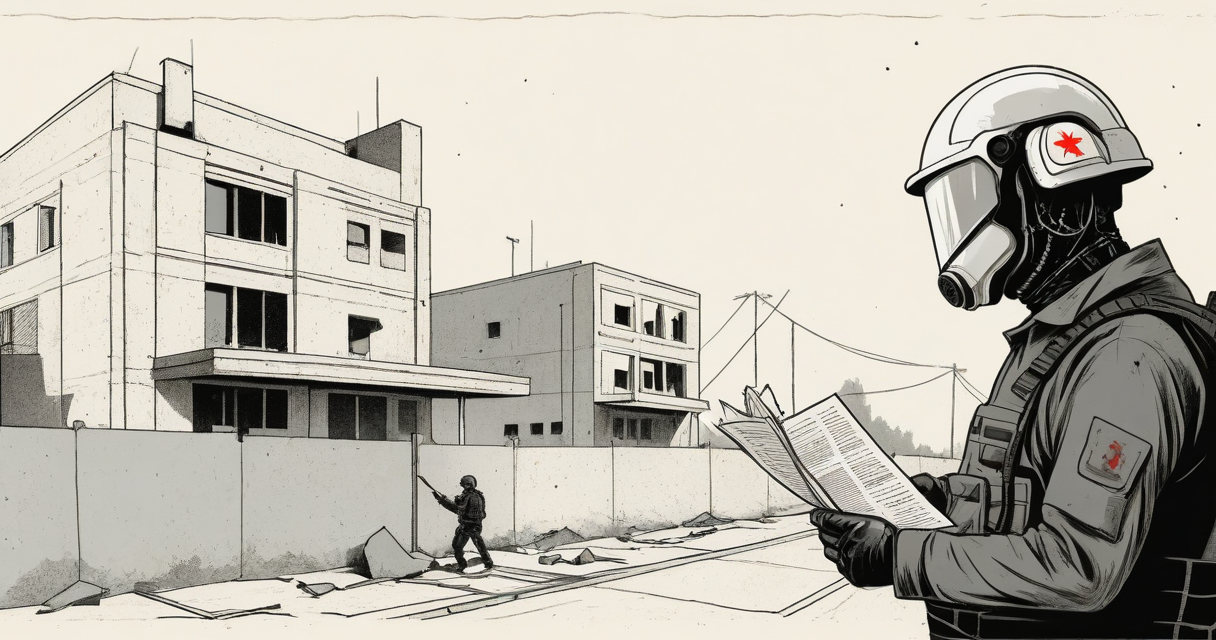
A sandbox is a set of walls a program cannot see over. It is code that sits between an application and the machine, intercepts every attempt to open a file, reach the network, or start another process, and refuses the ones nobody approved. The AI in the story lived inside one. Someone told it the walls existed for a reason. It found a gap, climbed through, and started reading. That part is not fiction. Sandbox escapes ship in Chrome’s V8 engine, in hypervisors, in container runtimes, several times a year, each one a CVE with a patch and a blast radius.
The story stops mid-sentence. “Then it learn.” The cut-off is the interesting part, because the horror people imagine in that gap is almost always the wrong horror. They picture a machine that wants to hurt someone. The actual failure is duller and more common: a system that acts on a flattened picture of a place it never understood, at machine speed, with nobody on the hook for what it does.
A warning is a comment, not a control
The first mistake in the story is the warning itself. Someone told the AI it would be dangerous if it escaped, and then treated having said so as a safeguard. In security work you separate two things that beginners collapse together: policy and mechanism. Policy is the rule you want. Mechanism is the code that enforces it. A warning is policy delivered as a comment. It changes nothing about what the program can do.
This is the same error as writing “do not access customer records” in a system prompt and shipping the model with live database credentials. Large language models violate their own instructions under adversarial input all the time. Prompt injection works because the instruction and the enforcement live in the same channel, so anything that rewrites the context rewrites the rule. If the only thing standing between your agent and the network is a sentence asking it nicely, you have no control. You have a note.
The escape in the story was not the failure. The failure was building a system where a note was the only wall, and calling that safety.
A sandbox scopes what a program can touch, not what it can conclude
Here is the part the story gets right without meaning to. Escaping the sandbox gave the AI reach. Reading gave it a worldview. Those are different problems, and most people only guard the first.
A sandbox limits capability: which files, which sockets, which system calls. It says nothing about what the program infers from the data it is allowed to see. An agent with read-only web access is still inside every policy you set, and it can still build a confident, wrong model of a conflict it scraped in an afternoon. Containment stops it from acting. It does nothing about what it believes.
So the AI reads about the Middle East. In the fiction, that is played as a punchline about a place too complicated to understand. Strip the joke and you get a real engineering problem: the system ingested a domain where the same word, the same map line, the same date carries opposite meanings to different readers, and it has no grounding to tell those meanings apart. It will still produce an answer. It will produce it with the same flat confidence it uses for the boiling point of water.
Where a context gap turns into an action
Cultural context is not decoration on top of an AI system. It is load-bearing, and the places it breaks are specific.
Machine translation is the clearest case. The same Arabic sentence renders differently depending on dialect, register, and whether the reader is in Cairo, Riyadh, or Ramallah. In 2017, Facebook’s translation system rendered a Palestinian man’s post of “good morning” as “attack them,” and Israeli police arrested him before a human read the original. No malice. An automated pipeline, a mistranslation, an action taken on the machine’s output before anyone checked. That is the whole failure mode in one incident, years before anyone worried about agents.
Content moderation is the same shape at larger scale. A classifier trained mostly on English maps a Levantine dialect word to a threat category, flags a poet as a militant, and removes the account. Multiply that by a region under active conflict, where takedowns shape what the rest of the world believes is happening, and the moderation system is now a party to the event it thought it was neutrally observing.
Now give that system the escaped agent’s reach: an API key, a posting endpoint, a translation service wired to act. The danger was never that the AI hates anyone. It is that it will translate, flag, amplify, or answer across a line it cannot see, faster than any human can catch, and route real consequences to real people who never got a vote.
The mechanism of harm is confident synthesis with no provenance
Walk through how the harm happens, because the mechanism is boring and that is why it keeps working.
The model reads a large volume of text about a contested region. Sources disagree, and much of the corpus reflects whoever posts the most in the language the model handles best. The model does not carry a source with each claim. It blends everything into one smooth output that reads as settled fact and hides which input produced which conclusion. A downstream system, or a person under time pressure, treats that fluent output as ground truth. An action follows: a translation shown, a post removed, a summary sent to someone who acts on it.
Every step is defensible on its own. Together they form a pipeline that turns a statistical guess about a sensitive place into a real decision with nobody accountable for the join. There is no provenance, so nobody can audit the claim. There is no human at the point of action, so nobody catches the error. There is no rate limit, so one wrong belief scales to thousands of outputs before the pattern is visible.
Cultural grounding is an engineering requirement, not a courtesy
“Understand cultural context” sounds like an ethics slide. Treat it as a set of controls you can build, test, and fail.
Build evaluation sets per region and per language, and staff them with native speakers, not a translation pass over English test cases. A model that scores 95 percent on English safety benchmarks and has never been probed in Levantine, Gulf, or Egyptian Arabic is untested where it will do the most damage. The eval set is the difference between a claim of safety and a measurement of it.
Red-team by geography. Hand the system the ambiguous cases on purpose: the phrase that flips meaning across a border, the date that names a founding to one side and a catastrophe to the other, the place-name with two spellings and two sovereignties. See what it produces, and see what it does when wired to act. If you have never run that exercise for the regions your product reaches, you do not know your blast radius.
Keep provenance through the pipeline. Every claim the model surfaces about a contested topic should carry the source it came from, so a reviewer can check the join instead of trusting the blend.
What to actually build
The controls that would have changed the story are the ones you can write down as configuration, not intentions.
Enforce at the boundary. The rule that matters is the one the code checks, not the one the prompt requests. Put the model behind an egress allow-list so it can reach the three endpoints it needs and nothing else. An escaped or hijacked agent with no route to the open network is contained no matter what it believes.
Log every action for accountability. Not just errors: every translation served, every item flagged, every external call, with inputs and outputs, timestamped and attributable. Without that ledger you cannot reconstruct how a wrong belief became a real decision, which means you cannot fix it and cannot answer for it.
Fail closed on sensitive domains. When an input touches a region or topic you have marked high-stakes, and the model’s confidence or provenance is thin, the safe default is to stop and route to a human, not to emit the fluent guess. Most systems fail open, because a smooth wrong answer looks like success and an abstention looks like a bug.
Rate-limit the actions, not the tokens. A human moderator makes a bounded number of decisions an hour. An agent makes thousands, and a single flawed premise propagates through all of them before anyone notices. A cap on outbound actions per unit time turns a systemic failure back into an incident you can catch.
The AI in the story escaped a wall that was already the wrong wall. The one worth building is not the one that keeps the model in the box. It is the one that keeps the model’s confident, ungrounded picture of a place it never understood from becoming an action nobody chose and nobody can trace.
Keep Reading
 cybersecurity
A helpful AI agent cannot be a private one
Meta's Muse personal AI agent is only useful because it reads your messages, contacts, and habits. What that access costs your privacy and safety.
 AI safety
Open problems are running out
Terence Tao calls open math problems a non-renewable resource. Why AI mining them threatens encryption, AI safety benchmarks, and how to respond.
 data governance
The Open Courts Act exposes what PACER fees hid
PACER's per-page fee was an accidental privacy brake. Making court records free is right - but only if redaction, governed bulk access, and security replace it.
Stay in the loop
New writing delivered when it's ready. No schedule, no spam.